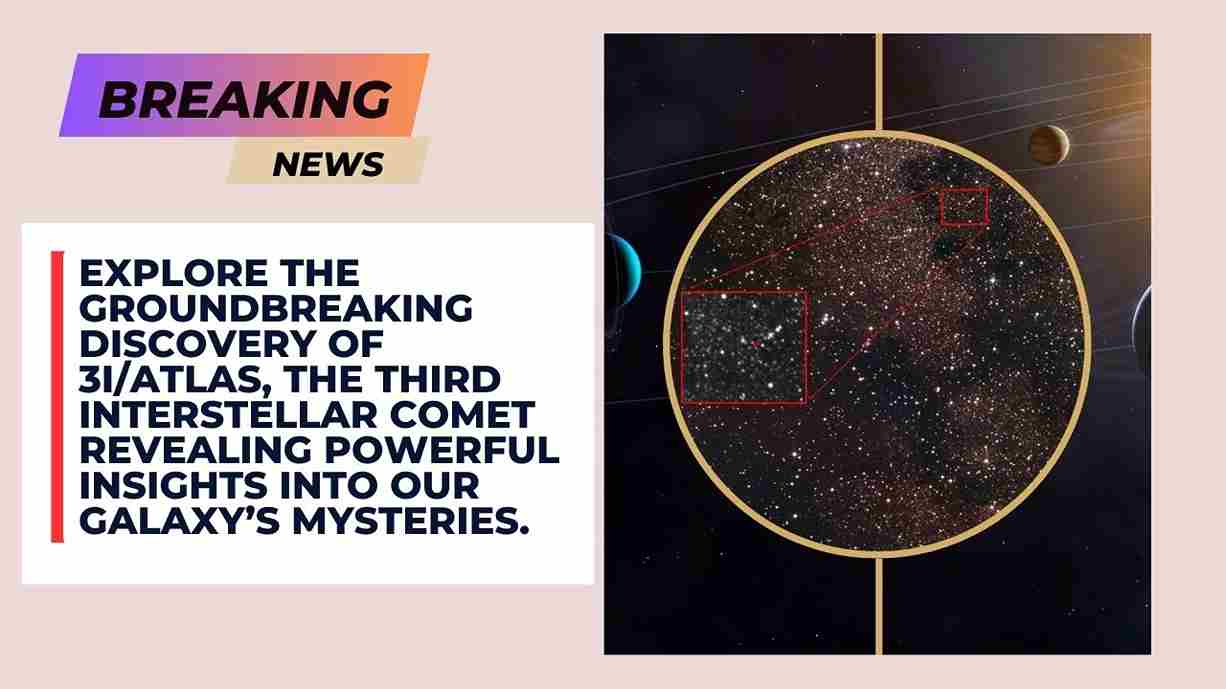

Interstellar comet 3I/ATLAS was discovered on July 1, 2025, by the NASA-funded ATLAS survey telescope in Chile. It is the third known object to come from outside our solar system. This comet travels in a hyperbolic orbit, proving it does not belong to the solar system. Instead, it comes into our solar space from deep interstellar space.
3I/ATLAS is moving very fast—about 137,000 miles per hour (221,000 kilometers per hour). It is one of the fastest objects ever recorded passing through the solar system. Scientists say this speed means it is just passing through and will leave our solar system eventually, never to return.
The comet is large, with an estimated nucleus size between 10 and 30 kilometers. It is bigger than earlier interstellar comets like 1I/’Oumuamua and 2I/Borisov. Scientists believe 3I/ATLAS may be over 7 billion years old. This possibly makes it the oldest comet ever observed. It likely originated from the Milky Way’s thick disk, a part of the galaxy with many ancient stars.
As 3I/ATLAS moves closer to the Sun, it gets warmer. This heat causes gas, dust and ice from its surface to vaporize, creating a bright coma—a cloud of gas surrounding the comet’s nucleus and a glowing tail. Recent photos from September 2025 show the comet may be turning bright green. This change in color is likely due to chemical reactions from sunlight and solar radiation.
The comet’s closest approach to the Sun will happen around October 30, 2025, when it will be about 1.4 astronomical units away (approximately 130 million miles). It will pass inside the orbit of Mars. After that, it will come as close as about 1.8 astronomical units (170 million miles) to Earth on December 19, 2025. This distance is safe, posing no threat to our planet.
Astronomers worldwide are actively studying 3I/ATLAS. They use Earth-based telescopes and space telescopes like the Hubble and Webb. These studies aim to learn more about the comet’s size, shape, speed and makeup. They have detected water ice and complex organic molecules in the comet. This information can help us understand the building blocks of planets and life in our galaxy.
Because of its unusual properties, some scientists, including Harvard astrophysicist Avi Loeb, have speculated about possible alien origins for 3I/ATLAS. This is a controversial idea, and further research is needed. Most experts agree that 3I/ATLAS is a natural comet from another star system.
3I/ATLAS is an exciting discovery. It offers a rare chance to study material from beyond our solar system. Scientists hope it will give new clues about how stars and planets form, as well as the conditions in the Milky Way many billions of years ago.
Subscribe to Updates
Get the latest creative news from FooBar about art, design and business.
Interstellar Comet 3I/ATLAS: The Third Interstellar Object Giving New Clues About the Galaxy
 By Editor Adeel3 Mins Read