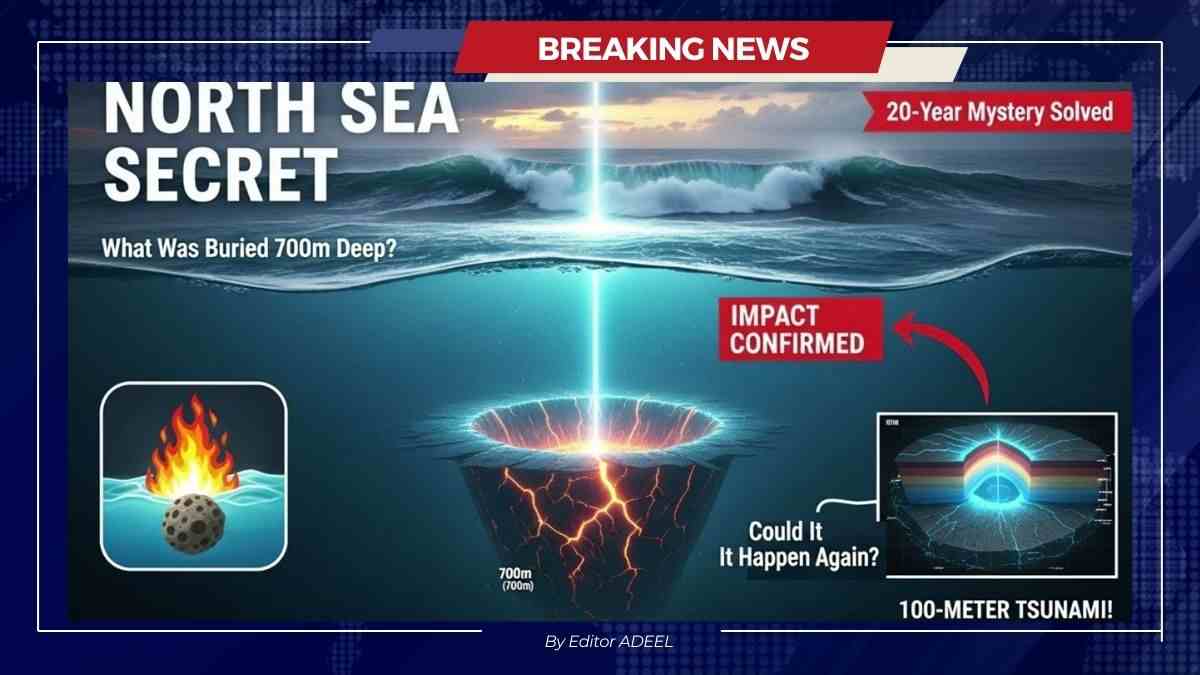

A massive asteroid slammed into the North Sea seabed millions of years ago. This event created the Silverpit Crater and triggered a huge tsunami. UK scientists have now confirmed it with new evidence. The discovery resolves a long debate about the crater’s origin.
The asteroid measured about 160 meters wide. It struck at a shallow angle from the west around 43 to 46 million years ago. The impact sent a 1.5-kilometre-high column of rock and water into the air. This collapsed quickly, forming waves over 100 meters, or 330 feet, high.
Researchers from Heriot-Watt University in Edinburgh led the study. They used advanced seismic imaging like an “ultrasound for the Earth.” This mapped the crater 700 meters below the seabed, about 80 miles off the Yorkshire coast. The 3-kilometre-wide crater sat amid circular faults stretching 20 kilometres.
Key proof came from shocked minerals in rock samples. These included quartz and feldspar crystals marked by extreme pressures that only impact can cause. Dr Uisdean Nicholson, the lead researcher, said, “Our evidence shows a 160-meter-wide asteroid hit the seabed at a low angle from the west.” He added, “Within minutes, it created a 1.5-kilometre high curtain of rock and water that collapsed, creating a tsunami over 100 meters high.” These findings leave “no doubt” about the impact.
The study appeared in Nature Communications. It links Silverpit to other craters like Chicxulub, which wiped out dinosaurs. Back then, the continents were shifting, but the North Sea area resembled today’s layout. The tsunami would have dwarfed modern storm surges, towering taller than Big Ben.
For UK residents, the crater lies hidden under the southern North Sea. It’s near busy shipping lanes and offshore wind farms. No threat exists today, but the event shows Earth’s wild past. Experts say such impacts shaped our planet’s geology.
Why did this happen? Asteroids hit Earth often in ancient times. Silverpit formed in shallow seas, unlike deep-ocean strikes. The low-angle hit amplified the tsunami by ejecting more material. Timing places it in the Eocene epoch, a warm period with no ice caps.
Current status focuses on science, not alarm. No new threats reported. Researchers urge better monitoring of near-Earth objects. UK space agencies track risks today. This find boosts planetary defence knowledge.
The discovery excites British scientists. It proves rare seafloor craters preserve impact history. Dr Nicholson called seismic scans crucial for hidden features. Future drilling might yield more samples.
The UK public can marvel at this prehistoric drama off our shores. It reminds us that space rocks still zip by. Staying informed aids safety. Heriot-Watt’s work highlights Scotland’s role in global research.
Subscribe to Updates
Get the latest creative news from FooBar about art, design and business.
Ancient North Sea Asteroid Strike Unleashed 330-Foot Tsunami Near Yorkshire, UK
 By Editor Adeel3 Mins Read