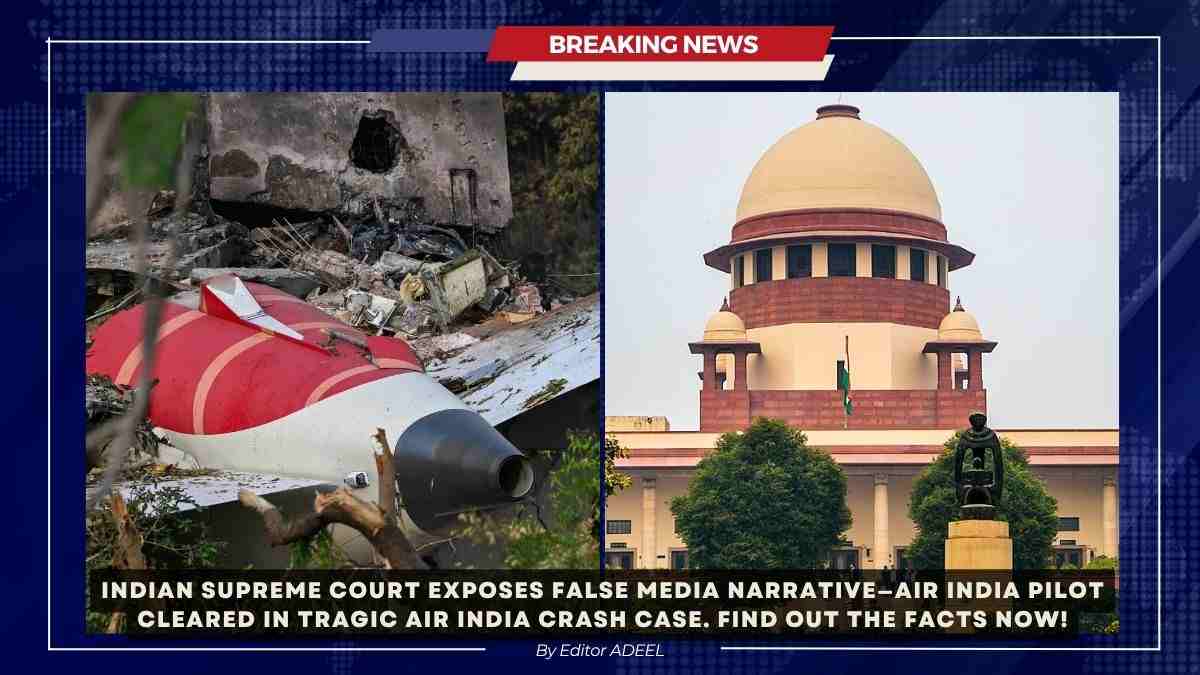

The Supreme Court in India declared that no one in the country held that the fatal Aur India crash in June was due to the failure of the captain and castigated an American publication that hurt his family.
On 13 June, an Air India Boeing Dreamliner, which was flying to London, crashed a few minutes after departing the western city of Ahmedabad. The ground force planes lost their power, lost their way and struck a medical college hostel located near the airport where 229 passengers, 12 members of the crew and 19 people who were on the ground perished.
Only one passenger survived. In a preliminary investigation report issued by the Indian government, the pilots were reported to have sounded confused before the crash as the fuel engine switches in the plane accidentally flipped simultaneously to the position of run to the position of cut-off shortly after the take-off.
The examination of the report indicated that first officer Clive Kunder was on the controls of the jet to take-off and to crash when the accident occurred. On the cockpit voice recorder Kunder was heard telling the other pilot, Captain Sumeet Sabharwal why he had thrown the switches, The Wall Street Journal reported at the time quoting unnamed sources.
The captain responded that he had not. Listening to a petition, which was brought by the father of the late captain, Pushkar Raj Sabharwal, Justices Surya Kant and Joymalya Bagchi observed on Friday that the pilot had no role to play in the tragedy.
Mr Sabharwal informed the court that two of the Aircraft Accident Investigation Bureau officials had attended him and insinuated that his son had cut the fuel supplied to the plane engines after take-off.
“It’s extremely unfortunate, this crash, but you should not carry this burden that your son is being blamed. Nobody can blame him for anything,” Justice Surya Kant told the bereaved father.
Justice Bagchi had further mentioned that the preliminary investigation report did not insinuate anything against the pilot.
There is no implication of blame in that report. The WSJ was called out by the court as having stated that the captain had switched off switches and that the coverage of the case by the American newspaper was mean and has hurt his family deeply.
“We are not bothered by foreign reports. Your remedy should then be before a foreign court. That is nasty reporting. No one in India believes it was the pilot’s fault,” the court said.
During a hearing before, in September, the court had noted that is was irresponsible to fire at the pilots relying on a preliminary probe which had been termed very clean and very thorough by the Indian government.
Subscribe to Updates
Get the latest creative news from FooBar about art, design and business.
Top court says pilot is not at fault for Air India crash and criticizes ‘nasty’ media coverage
 By Editor Adeel3 Mins Read