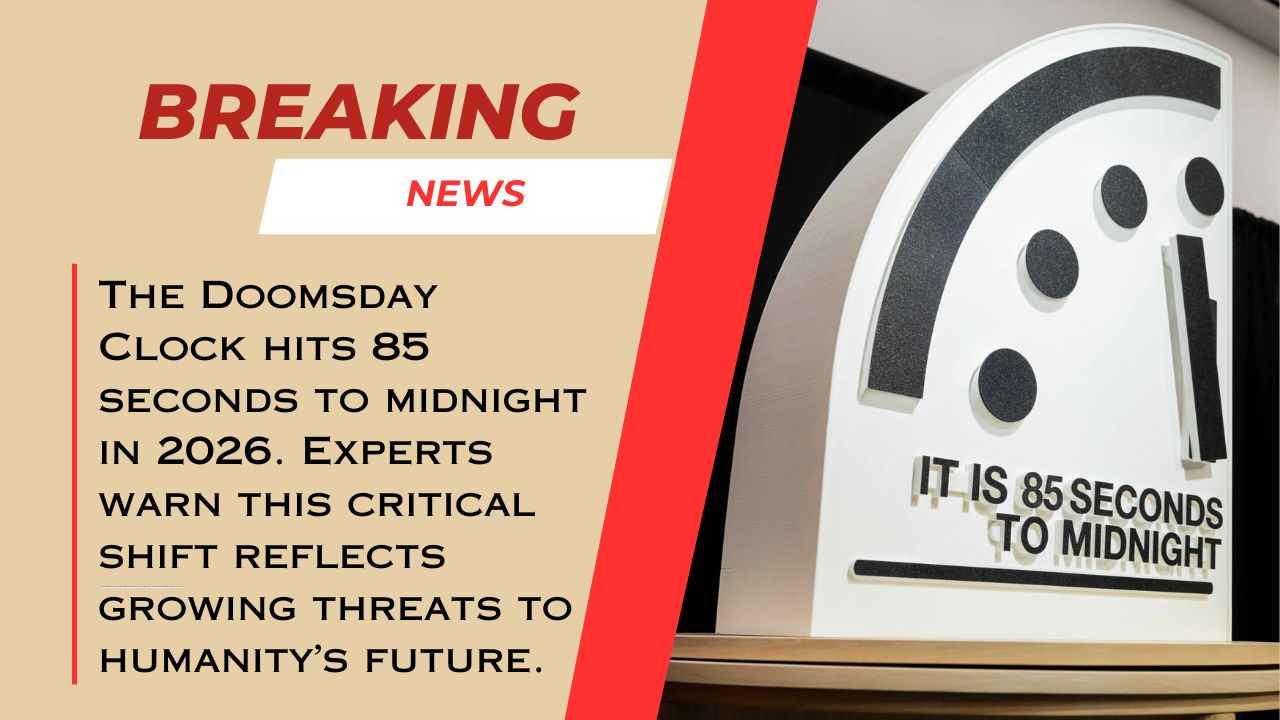

The Doomsday Clock has been moved closer to “midnight” than ever before, scientists have warned. On January 27, 2026, the Bulletin of the Atomic Scientists set the clock at 85 seconds to midnight, four seconds nearer than in 2025. This is the closest the symbolic block has been to a global catastrophe since it was first created in 1947.
The Doomsday Clock is not a real clock. It is a metaphor created by scientists to show how close humanity is to self-destruction. Midnight stands for a global disaster, such as nuclear war, and climate collapse is self-destruction. Midnight stands for a global disaster, such as nuclear war, climate collapse, or other man-made threats. The closer the hands move to midnight, the more urgent the warning becomes.
In its 2026 statement, the Bulletin said the world is at its most dangerous point in history. It blamed rising nuclear tensions, worsening climate change, and rapid advances in artificial intelligence and biotechnology. The group also pointed to the spread of misinformation, political extremism, and a “failure of leadership” in many countries.
The Bulletin’s Science and Security Board cited the behaviour of major nuclear powers such as the United States, Russia, and China. It said these nations have taken more aggressive, confrontational and nationalistic positions instead of cooperating on arms control Treaties that once limited nuclear weapons are weakening or expiring, the group added.
Climate change remains a major concern. Scientists noted that global temperatures are still rising and that countries are not cutting greenhouse gas emissions fast enough. Extreme weather, heatwaves, floods, and sea-level rise are already harming people and economies. Without stronger action, these risks will grow.
The 2026 statement also highlighted dangers from new technologies. Artificial intelligence, cyber threats, and powerful biotechnologies can be used for both good and harm. The Bulletin warned that weak rules and poor oversight could turn these tools into serious threats to security and democracy.
The group stressed that the clock is not predicting an exact date for a disaster. Instead, it is a warning that humanity has the power to change course. It called on governments, businesses, and citizens to reduce nuclear risks, act on climate change, control dangerous technologies, and rebuild trust in science and facts.
Despite the alarming setting, the Bulletin said there is still time to step back from the edge. It urged world leaders to restart dialogue, strengthen international law, and invest in peaceful solutions. The message is clear: the world is closer to catastrophe than ever, but it is not too late to turn the clock back.
Subscribe to Updates
Get the latest creative news from FooBar about art, design and business.