

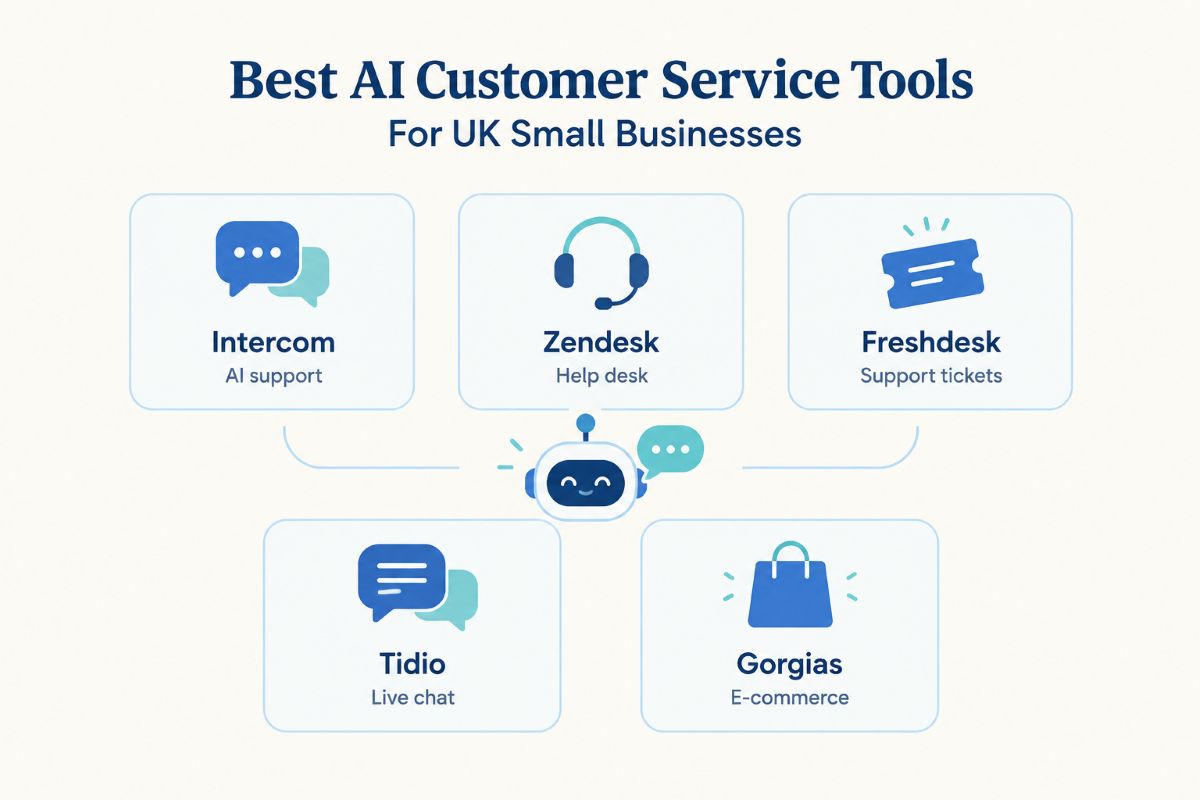
AI customer service tools can help small businesses answer routine questions, organise support requests and respond outside normal working hours without hiring a large support team. The right platform can handle common enquiries while allowing staff to focus on complaints, unusual requests and customers who need personal help.
For most small businesses, the decision comes down to three things: which channels customers use, how much support you receive and whether you need a chatbot, a full helpdesk or both.
This comparison covers six options worth considering in 2026, with practical guidance on features, costs, limitations and UK data-protection considerations.
The Best AI Customer Service Tools at a Glance
| Tool | Best suited to | Main consideration |
|---|---|---|
| Tidio | Website chat and small online businesses | AI conversation limits and add-on costs |
| Freshdesk | Email support and ticket management | AI usage and optional features |
| Intercom | AI-led messaging and digital support | Per-seat fees plus AI usage |
| Zendesk | Growing teams handling several channels | Higher costs as requirements expand |
| Zoho Desk | Businesses wanting support software within a wider business suite | Features vary by plan |
| Gorgias | Shopify and ecommerce brands | Ticket allowances and AI interaction charges |
6 Best AI Customer Service Tools
There is no universal winner. A small service business handling enquiries through its website may need only a simple chat tool, while an online retailer dealing with delivery updates, returns and order problems may benefit from a helpdesk connected to its shop.
1. Tidio — Best for Website Chat and Small Businesses
Tidio combines website live chat, a shared inbox, automated workflows and its Lyro AI Agent. It is a practical starting point for small businesses that want to answer common website questions without building a complex support system.
Lyro can respond using the information supplied to it, while human agents can take over conversations that require personal attention. The platform is particularly relevant to small ecommerce shops, appointment-based businesses and service providers that receive repeated questions about products, availability or opening hours.
Pricing: Tidio’s published pricing includes a free plan and a Starter plan listed at $24.17 per month with annual billing, with higher plans available. The Starter plan includes 100 billable conversations and a one-off allowance of 50 Lyro AI conversations, so check the separate AI quota before estimating your costs. See Tidio’s official pricing.
Advantages
- Website chat and AI support in one platform.
- A relatively accessible starting point for smaller teams.
- Useful for handling repeated questions and directing visitors.
Limitations: AI conversations and ordinary support conversations have separate limits. Businesses with rising traffic should calculate the full subscription and usage costs rather than choosing a plan by its headline price alone.
Best for: A small UK business that wants to add AI-assisted chat to its website without replacing its entire customer service setup.
2. Freshdesk — Best for Email Support and Ticket Management
Freshdesk is a strong option for businesses that receive customer enquiries through email and need a more organised way to track them. Its ticketing system helps teams assign requests, follow progress and keep customer conversations together.
Freshdesk’s Freddy AI features include AI-assisted support capabilities and an AI Agent. The Growth plan is listed at $19 per agent per month with annual billing and includes the first 500 AI Agent sessions. Additional sessions are charged separately; Freshworks lists $49 for another 100 sessions on its pricing page. Check current Freshdesk pricing.
Advantages
- Centralises customer requests in a ticketing system.
- Helps teams organise, assign and monitor support work.
- Provides a route from basic email support to more advanced workflows.
Limitations: The cost depends on the number of agents, the plan selected and how much AI is used. Some advanced features and AI assistance may require a higher tier or paid add-on.
Best for: Small businesses with a growing volume of customer emails, repeat support issues or several people handling enquiries.
3. Intercom — Best for AI-Led Messaging
Intercom is designed for businesses that want customer messaging, support tickets, a help centre and AI assistance working together. Its Fin AI Agent can answer questions across supported channels and pass conversations to human agents when necessary.
The platform may suit software companies, online services and digital businesses where customers need help with account access, product features or getting started.
Pricing: Intercom’s Essential plan starts at $29 per seat per month with annual billing. Fin is charged separately at $0.99 per outcome for the relevant chat and email usage. Advanced and Expert plans cost more. An outcome is determined under Intercom’s billing rules, so it is worth reading the definitions before estimating monthly spend. See Intercom’s pricing and billing details.
Advantages
- Combines an AI agent with a shared inbox and help centre.
- Supports digital customer conversations in one workspace.
- Offers more advanced workflow options on higher plans.
Limitations: Per-seat subscriptions and usage-based AI charges can make costs less predictable. A small business should estimate both human-agent seats and likely AI outcomes before committing.
Best for: A digital business that wants AI to handle a meaningful share of routine customer conversations while keeping human support available.
4. Zendesk — Best for a Growing Multi-Channel Support Team
Zendesk is worth considering when customer service involves more than a shared inbox. It provides ticketing, routing, reporting and support across channels, with AI agent features available on relevant plans.
It can be useful for businesses that expect to grow their support operation, need clearer reporting or want a more structured way to manage customer issues across email, messaging and other channels.
Pricing: Zendesk’s published annual prices include Support Team at $19 per agent per month and Suite Team at $55 per agent per month. The Suite Team plan includes AI agents, a knowledge base and broader support-channel features. Check the current Zendesk pricing page to confirm which features and usage charges apply to your chosen plan.
Advantages
- Established ticketing and support workflows.
- Useful reporting and ticket-routing capabilities.
- A range of options for teams with different levels of complexity.
Limitations: The entry-level ticketing plan does not include every feature available in the wider suite. Costs can increase as a business adds channels, agents and AI usage.
Best for: A growing small business that needs a structured support operation rather than a standalone chatbot.
5. Zoho Desk — Best for Businesses Using Zoho
Zoho Desk is a customer support platform with email ticketing, workflow automation and AI-related features. It is particularly worth investigating if your business already uses other Zoho products and wants customer service to fit into the same business software environment.
Zoho’s current pricing page lists a free edition for up to three users and paid editions with additional features. Its Express plan is listed at ₹420 per user per month with annual billing on the pricing page, but that is an India-market price rather than a UK quote. UK businesses should select their market and currency to confirm the applicable price. See Zoho Desk pricing.
Advantages
- Free entry-level option for a very small team.
- Ticketing and workflow features.
- AI options that vary by edition and configuration.
Limitations: The availability of specific AI features depends on the selected edition and setup. Check whether the functions you need are included before comparing it with a more specialised AI service.
Best for: A small business that wants customer support software which can work alongside its existing Zoho tools.
6. Gorgias — Best for Shopify and Ecommerce Support
Gorgias focuses on conversational commerce and is especially relevant to Shopify brands. It connects customer conversations with ecommerce information, helping support teams deal with common questions about orders, deliveries, returns and products.
Its AI Agent can resolve supported conversations automatically, with charges based on qualifying AI-resolved interactions. Gorgias explains that its AI Agent is an add-on to the helpdesk and that the two have separate pricing structures.
Pricing: The Gorgias Starter helpdesk plan is listed at $10 per month for 50 billable tickets. AI Agent usage is additional; most plans list $0.90 per resolved interaction with annual billing or $1.00 with monthly billing, while Starter AI pricing may differ. Review Gorgias pricing and its AI Agent pricing explanation.
Advantages
- Designed around ecommerce customer conversations.
- Useful for order-related questions and common retail support requests.
- AI charges are linked to qualifying automated resolutions rather than simply the number of staff accounts.
Limitations: It is more specialised than a general-purpose helpdesk. Ticket allowances and AI usage need to be considered together, especially during busy sales periods.
Best for: A Shopify retailer that receives frequent order, delivery, product and returns enquiries.
How to Choose the Right AI Customer Service Tool
Before subscribing, map out the questions customers ask most often. A business that receives ten daily enquiries about opening hours has different needs from an online retailer managing hundreds of delivery and return requests.
Use these steps to make a sensible shortlist.
Start with your main support channel
If customers mainly contact you through your website, begin with a chat-focused platform such as Tidio. If most requests arrive by email, compare ticketing tools such as Freshdesk, Zendesk and Zoho Desk. Ecommerce brands should also consider how closely a platform connects to their shop and order data.
Calculate the full monthly cost
Do not compare subscription prices alone. Check:
- Cost per agent or user.
- AI conversation, session or resolution charges.
- Monthly ticket or conversation limits.
- Paid integrations and add-ons.
- VAT, billing currency and annual-contract terms.
Estimate your costs at today’s volume and at a busier level. That helps you see whether the tool will remain affordable as the business grows.
Test the AI with real questions
Before making the chatbot public, test it with common customer enquiries, awkwardly phrased questions and requests that need human help. Check that its answers match your policies and that it does not invent delivery promises, refund rules or product details.
A good tool should make it easy to correct its information and hand a conversation to a person.
UK Data Protection: What Small Businesses Should Check
If an AI tool processes customer names, email addresses, order details or conversation histories, data protection needs to be part of the buying decision.
The Information Commissioner’s Office (ICO) provides guidance on applying data protection law to AI systems. It also notes that its AI guidance is under review following changes made by the Data (Use and Access) Act, so businesses should check the latest guidance rather than relying on an old checklist. Read the ICO’s AI and data protection guidance.
Before choosing a provider, review its data processing terms, retention settings, security controls, subprocessors and available data-hosting options. Establish what information the AI can access and how customers can reach a human. Avoid giving a chatbot access to sensitive information or account-changing actions unless the controls have been carefully assessed.
The business remains responsible for how it uses customer data, even when a third-party provider supplies the AI system.
Frequently Asked Questions
What is the best AI customer service tool for a small UK business?
There is no single best option for every business. Tidio is a useful starting point for website chat, Freshdesk for ticket-based email support, Intercom for AI-led messaging, Zendesk for growing multi-channel teams and Gorgias for Shopify retailers.
Are there free AI customer service tools?
Some providers offer free plans or limited AI conversation allowances. Tidio has a free plan, and Zoho Desk offers a free edition for up to three users. Check the limits carefully, because a free helpdesk plan may not include a large AI allowance or every automation feature.
How much do AI customer service tools cost?
Costs range from free entry-level options to subscriptions with per-agent fees and usage-based charges. For example, Freshdesk Growth is listed at $19 per agent per month with annual billing, while Intercom Essential starts at $29 per seat per month plus applicable Fin usage. Confirm current prices and UK billing terms before buying.
Can AI customer service tools replace human agents?
They can automate some routine enquiries, but they should not be expected to handle every customer situation. Complaints, unusual cases, sensitive requests and decisions with significant consequences often need human judgement. Keep a clear route to a person.
Final Recommendation
Choose an AI customer service tool based on the work you need it to do, not the size of its feature list. Start with your main customer channel, calculate subscription and usage costs, and test the AI against real enquiries before switching it on for everyone.
For many small businesses, a limited pilot that answers a few common questions is a better first step than automating the entire customer service process at once.