


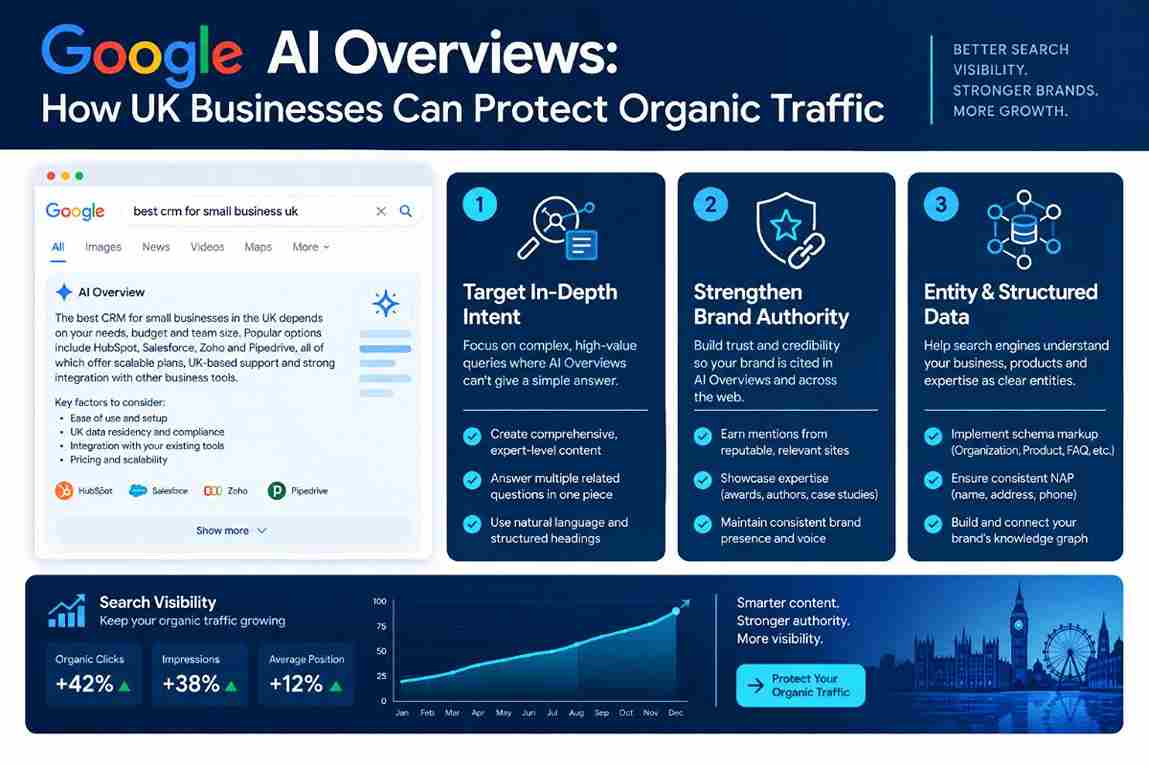
Google Search is changing from a list of blue links into an increasingly conversational experience. For UK businesses, that creates a difficult question: if Google can answer part of a search directly, will people still visit your website?
The answer is not simply to publish more content or chase an “AI SEO” trick. Protecting organic traffic in 2026 means making your website useful enough to be selected, cited and visited when Google’s AI features help users research a topic. It also means measuring visibility differently and strengthening the parts of your search strategy that AI cannot easily replace.
Google expanded AI Overviews to the UK in 2025 and launched AI Mode there later that year. By 2026, AI Overviews and AI Mode had become part of a broader Google Search experience rather than an isolated experiment.
What are Google AI Overviews?
Google AI Overviews provide an AI-generated summary at the top of some search results, with links to supporting websites. They are designed to answer more complex questions quickly while giving users routes to explore the underlying sources.
AI Mode goes further by allowing users to ask longer questions, compare options and continue with follow-up queries. Google says AI Mode can break a complicated question into multiple related searches, allowing it to find supporting information from a wider range of web pages.
For businesses, this changes the search journey.
A potential customer might no longer search for a single keyword, open several websites, and compare them manually. They may ask Google a detailed question and then visit only the sources that appear useful within the AI response.
That makes visibility, authority and the quality of the page behind the search result increasingly important.
Are AI Overviews reducing organic traffic?
They can change how organic traffic is generated, but there is no universal percentage that applies to every website.
Some searches may receive an AI-generated answer that satisfies the user without a click. Other searches can lead to more detailed exploration and clicks to supporting websites.
Google itself says that clicks from search results containing AI Overviews can be higher quality, with users more likely to spend time on the sites they visit. Google has also said that AI features are sending billions of clicks to websites each week. These are Google’s own observations, rather than a guarantee for individual businesses.
The more useful question for a business is therefore not:
“Will AI kill my Google traffic?”
It is:
“Which searches still need a website, and why would someone choose mine?”
That question leads to a much stronger SEO strategy.
1. Stop building pages that only repeat existing information
One of the biggest risks in an AI-heavy search environment is publishing content that adds little beyond what Google can already summarise.
If ten websites explain the same basic definition using almost identical wording, there is little reason for a user or search system to prefer one over another.
Google’s current guidance for generative AI search specifically emphasises valuable, unique and non-commodity content. It also recommends adding original perspectives, useful analysis and information that goes beyond material easily reproduced elsewhere.
For a UK business, that could mean adding:
- UK-specific examples
- Original comparisons
- Clear pricing considerations
- First-hand observations where genuinely available
- Screenshots or demonstrations
- Original research or data
- Practical implementation advice
- Expert commentary that can be verified
- Examples showing how a recommendation works in practice
A page should give the reader a reason to continue beyond the AI summary.
2. Answer the main question quickly
AI search rewards clarity because its systems need to understand what a page actually says.
That does not mean writing robotic, one-paragraph answers for every keyword. Instead, put the useful answer near the beginning and then develop it.
For example, an article targeting “how much does SEO cost in the UK?” should not spend 500 words discussing the history of search engines before mentioning pricing.
Start with the main factors affecting cost, then explain different approaches, limitations and examples.
This structure helps three audiences at once:
- People who want a quick answer.
- Search engines trying to understand the page.
- Readers who need more detail before making a decision.
Google says there are no special technical requirements or special schema needed specifically for AI Overviews or AI Mode. The same fundamental SEO practices remain important.
3. Build topic depth instead of chasing isolated keywords
AI Mode can handle longer and more complex questions, so businesses should think beyond individual keywords.
Suppose a UK software company sells accounting software.
A single article about “accounting software” is unlikely to cover every useful question. A stronger content cluster might include:
- Accounting software for small UK businesses
- Cloud accounting vs desktop accounting
- VAT accounting software explained
- How to choose accounting software
- Accounting software pricing
- Common accounting software mistakes
- Accounting software for contractors
- How to migrate accounting data
These pages can support one another through internal links.
The goal is not to create dozens of thin articles. It is to build a useful information network around a subject that the business genuinely understands.
Google’s own guidance recommends making important content easy to discover through internal links.
4. Give Google clear signals about what your business does
A business website should make its purpose obvious.
Your homepage, service pages, About page and supporting content should collectively answer:
- Who is the business?
- What does it offer?
- Where does it operate?
- Who does it serve?
- What makes its offering different?
- Why should someone trust it?
This becomes particularly useful as search becomes more conversational.
Someone might ask Google:
“Which UK web design companies specialise in small businesses?”
A business with clear service information, relevant case studies, location information and evidence of expertise gives search systems much more useful material to work with than a site containing generic marketing copy.
For local businesses, keep business information and profiles accurate and consistent. Google specifically recommends keeping Business Profile information up to date as part of its guidance for AI search visibility.
5. Strengthen the content that AI cannot easily replace
The safest organic traffic is not necessarily traffic from the largest number of generic informational searches.
Consider what makes someone need your website rather than just an answer.
This could include:
- Product comparisons
- Original tools and calculators
- Detailed how-to instructions
- Templates
- Case studies
- Original research
- Local recommendations
- Product demonstrations
- Expert analysis
- Reviews based on genuine experience
- Interactive features
These assets give users a reason to leave the search results.
Google’s generative AI guidance makes a similar point: unique perspectives and genuinely useful content are more valuable than material that simply repeats information already available online.
6. Don’t ignore traditional SEO
One common mistake in 2026 is treating “GEO” as a replacement for SEO.
Google explicitly says that existing SEO fundamentals remain relevant for AI Overviews and AI Mode. A page needs to be indexed and eligible to appear in normal Google Search before it can be eligible as a supporting link in these AI features.
That means businesses still need to care about:
- Crawlability
- Indexing
- Internal linking
- Useful page titles
- Descriptive headings
- Mobile usability
- Page experience
- Accessible text
- High-quality images where appropriate
- Accurate structured data
- Helpful, reliable content
There is no secret “AI schema” that guarantees inclusion in an AI Overview.
7. Measure visibility beyond clicks
Organic traffic is still important, but clicks alone do not tell the entire story.
Google introduced dedicated Search Generative AI performance reports in Search Console in 2026, providing visibility into impressions from generative AI features such as AI Overviews and AI Mode. The reporting was rolled out globally by the end of August 2026.
Businesses should therefore monitor several signals:
- Organic impressions
- Organic clicks
- Search queries
- Click-through rate
- AI-feature visibility
- Engagement after the visit
- Leads or sales
- Conversion rate
- Branded search growth
- Performance of important landing pages
A page can lose some clicks while becoming more visible for a wider range of complex searches. Conversely, a page can retain rankings while attracting less valuable traffic.
The business outcome matters more than one metric.
8. Refresh important pages instead of endlessly publishing new ones
If an existing article has useful backlinks, historical visibility or strong topical relevance, improving it may be more valuable than publishing another article targeting a slightly different keyword.
Review older pages for:
- Outdated statistics
- Broken links
- Old product information
- Missing UK context
- Weak introductions
- Poor internal links
- Repeated or generic sections
- Questions users now ask
- Information competitors have added
Google’s guidance encourages creators to provide substantial value and original analysis rather than simply producing more pages. It also warns against creating content primarily because of perceived search-engine demand.
A smaller library of genuinely useful pages can be stronger than a large archive of interchangeable articles.
9. Build traffic sources outside Google
Protecting organic traffic does not mean becoming completely dependent on Google.
Businesses should also consider:
- Email newsletters
- YouTube
- Industry communities
- Direct traffic
- Referral partnerships
- Social media
- Repeat customers
- Branded searches
This is particularly important because search behaviour is spreading across traditional search, AI assistants and other discovery platforms.
Recent UK research from Figment, based on 21 business websites, found that identifiable AI assistants accounted for 0.98% of sessions in its June–September 2026 sample. The figure does not include Google AI Overview clicks, which are recorded as organic search in GA4.
That is not a universal benchmark, but it illustrates why businesses should begin measuring where discovery is actually coming from rather than assuming every visitor starts with a traditional Google result.
What should UK businesses do first?
If organic traffic is already falling, do not respond by publishing 50 new AI-assisted articles.
Start with an audit.
- First, identify your most valuable pages. Look at the pages that historically generated organic clicks, leads, sales or strong engagement.
- Next, check what has changed. Compare current rankings, impressions, click-through rates and search intent with previous periods.
- Then improve the pages that still have potential. Add current information, stronger explanations, original examples, useful media and better internal links.
- Finally, check Search Console’s generative AI reporting to understand whether your content is appearing in AI-powered search experiences.
This approach is more useful than trying to predict exactly how Google’s next AI update will behave.
Frequently asked questions
Do I need special GEO schema for Google AI Overviews?
No. Google says there are no additional technical requirements or special schema.org markup specifically required for AI Overviews or AI Mode. Normal SEO fundamentals still apply.
Can a small UK business appear in AI Overviews?
Yes. Google does not restrict AI-feature visibility to large brands. A page must be indexed and eligible to appear in normal Google Search, while useful, relevant and trustworthy content can provide supporting information for AI responses. Inclusion is never guaranteed.
Should businesses stop targeting informational keywords?
No. Informational searches can still introduce potential customers to a business. The stronger strategy is to create genuinely useful informational content and connect it naturally to products, services and deeper resources.
How can I see whether AI search is affecting my website?
Use Google Search Console’s Performance reports, including its dedicated generative AI reporting where available, and combine this with Google Analytics data for engagement and conversions.
Final thoughts
Google AI Overviews do not make organic traffic irrelevant. They change the path users take to reach a website.
UK businesses should focus less on trying to “optimise for AI” as a separate discipline and more on creating pages that deserve to be discovered: clear answers, original information, strong expertise, useful supporting resources and a reason for the reader to visit.
The practical priority for 2026 is straightforward: protect the pages that already matter, improve their usefulness, build deeper topic coverage and measure visibility across both traditional and generative search. That gives a business a much stronger foundation than chasing the latest SEO shortcut.